The human body maintains balance and coordination through two great communication networks: the nervous system, which relies on rapid electrical impulses, and the endocrine system, which uses hormones as slower but longer-lasting messengers. The critical link that integrates these two systems is the pituitary gland, working hand-in-hand with the hypothalamus.
Together, the hypothalamus and pituitary form the neuroendocrine axis—a sophisticated regulatory hub that connects the brain’s neural signals with the endocrine output required to regulate growth, reproduction, stress response, metabolism, and water balance.
The Pituitary Gland: The Master Gland
Often called the “master gland”, the pituitary gland (or hypophysis) is a pea-sized organ located at the base of the brain within a small bony cavity called the sella turcica. Despite its small size, the pituitary has vast influence, as it secretes hormones that either act directly on tissues or stimulate other endocrine glands such as the thyroid, adrenal glands, ovaries, and testes.
The pituitary has a dual embryological origin, which explains its structure and functions:
- Anterior Pituitary (Adenohypophysis): Derived from the oral ectoderm (Rathke’s pouch). This lobe is composed of hormone-secreting epithelial cells that store hormones in granules and release them into the bloodstream.
- Posterior Pituitary (Neurohypophysis): Derived from the neural ectoderm of the brain. Unlike the anterior lobe, it does not synthesize its own hormones. Instead, it stores and releases neurohormones—oxytocin and vasopressin (ADH)—produced by neurons in the hypothalamus.
The Hypothalamus–Pituitary Connection
The hypothalamus, located just above the pituitary, acts as the command center. It constantly monitors internal conditions such as temperature, hydration, energy balance, and stress. Based on these signals, it secretes releasing or inhibiting hormones that control pituitary activity.
Communication between these two structures occurs through:
- The Hypophyseal Portal System (vascular link): Small blood vessels carry hypothalamic releasing hormones (e.g., GnRH, CRH, TRH, GHRH) directly to the anterior pituitary, where they stimulate or suppress hormone release.
- Neural Pathways (nerve link): Hypothalamic neurons project down into the posterior pituitary, releasing oxytocin and vasopressin directly into the bloodstream.
Hormones of the Anterior Pituitary
The anterior pituitary produces several tropic hormones (which regulate other glands) and direct hormones (which act directly on tissues):
- Growth Hormone (GH): Stimulates growth, protein synthesis, and metabolism.
- Thyroid-Stimulating Hormone (TSH): Activates the thyroid to produce thyroxine (T4) and triiodothyronine (T3), regulating metabolism.
- Adrenocorticotropic Hormone (ACTH): Stimulates the adrenal cortex to release cortisol, crucial for stress response and metabolism.
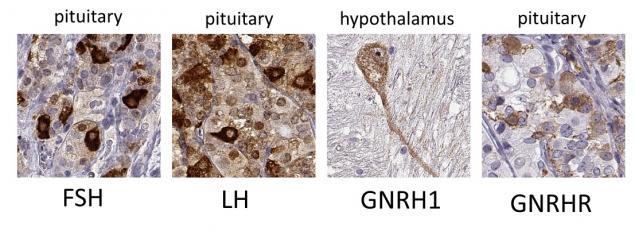
- Follicle-Stimulating Hormone (FSH): Promotes development of ovarian follicles in women and sperm production in men.
- Luteinizing Hormone (LH): Triggers ovulation in women and testosterone production in men.
- Prolactin (PRL): Stimulates breast development and milk production.
Hormones of the Posterior Pituitary
The posterior pituitary does not synthesize hormones but stores and secretes those made by the hypothalamus:
- Oxytocin: Stimulates uterine contractions during labor and milk ejection during breastfeeding. It also plays a role in bonding and social behaviors.
- Vasopressin (Antidiuretic Hormone, ADH): Regulates water balance by signaling the kidneys to reabsorb water, preventing dehydration.
Example: The Reproductive Axis
One of the clearest illustrations of the nervous-endocrine link is the hypothalamic–pituitary–gonadal (HPG) axis:
- The hypothalamus releases GnRH (gonadotropin-releasing hormone).
- GnRH stimulates the anterior pituitary to secrete FSH and LH.
- FSH and LH act on the gonads—stimulating estrogen, progesterone, and testosterone production, as well as gamete development.
- Sex steroids then feedback on both the hypothalamus and pituitary, fine-tuning the system.
This axis regulates puberty, fertility, sexual behavior, and even mood changes.
Integration of Endocrine and Nervous Systems
The pituitary gland is not an isolated structure. It acts as a translator between neural signals and hormonal responses. For example:
- Stress Response: The hypothalamus senses stress → CRH is released → pituitary secretes ACTH → adrenal cortex produces cortisol → body mobilizes energy.
- Water Balance: Hypothalamus detects increased plasma osmolality → posterior pituitary releases ADH → kidneys conserve water.
- Growth: Hypothalamus secretes GHRH → pituitary releases GH → bones and muscles grow.
In this way, the pituitary ensures that neural signals from the brain can orchestrate body-wide hormonal adjustments.
Clinical Importance
Because the pituitary influences nearly every endocrine gland, disorders can have wide-reaching effects:
- Pituitary Adenomas: Benign tumors may cause hormone overproduction (e.g., acromegaly from excess GH) or underproduction.
- Hypopituitarism: Reduced pituitary hormone secretion can result from injury, surgery, or genetic conditions, leading to multiple endocrine deficiencies.
- Diabetes Insipidus: Caused by insufficient ADH secretion, leading to excessive urination and thirst.
Diagnosis often involves measuring circulating hormone levels and imaging the pituitary gland.
Conclusion
The pituitary gland, working in concert with the hypothalamus, is the body’s primary neuroendocrine bridge, seamlessly integrating the nervous system’s fast signals with the endocrine system’s long-lasting hormonal responses. Through its anterior and posterior lobes, the pituitary regulates growth, reproduction, metabolism, stress responses, water balance, and more.
It is the perfect example of how the human body maintains balance through dual communication networks, ensuring survival and adaptation in an ever-changing environment.